
JACK RUSSELL TERRIER
HISTORY OF THE JACK RUSSELL TERRIER
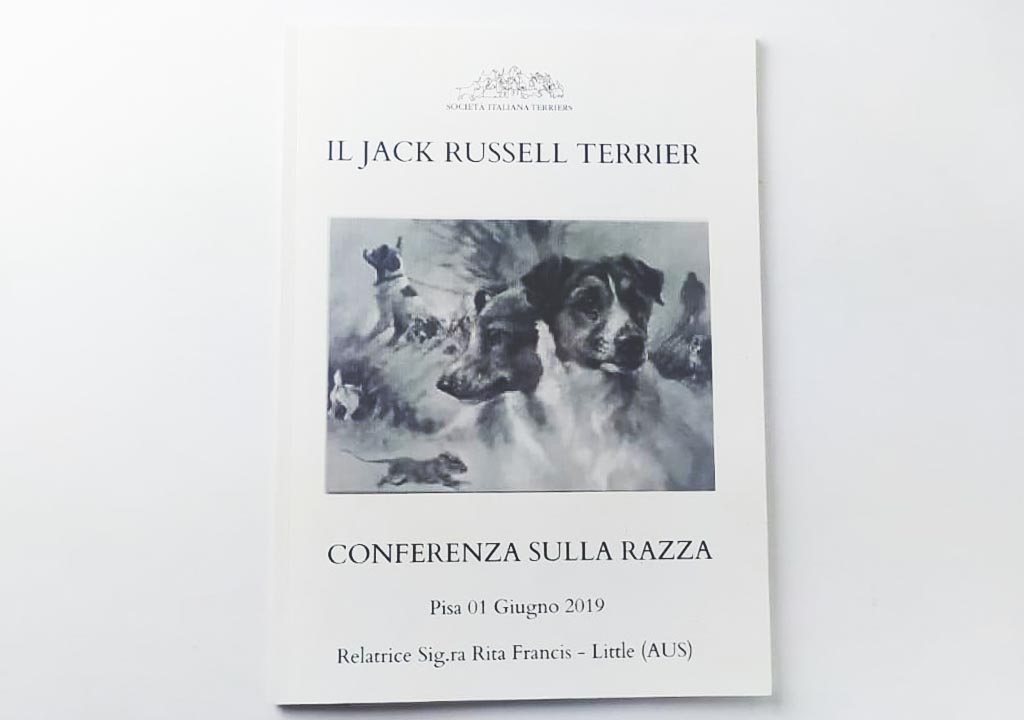
The Jack Russell Terrier that we know today had its beginnings as far back as 1819, when the Rev. John (Jack) Russell saw and purchased a small white terrier bitch, from a milkman near Marston, a village outside Oxford UK. Jack Russell was born in Devonshire, England in 1795 and died at Black Torrington in 1883.
As a student, he won an Exhibition to Exeter College, Oxford, where he took Holy Orders. During this time he was often a guest of the various Hunts nearby, named Heythrop and Beaufort.
He was a founder member of UK Kennel Club, and a Judge who counted amongst his friends the Prince of Wales, later Edward the 7th.
A painting of Jack Rusell's foundation bitch “Trump” hangs in the saddle room at Sandringham Castle, which was purchased by the Prince of Wales after Jack Russell's death.
The portrait shows a white bodied terrier, with colour on the head and a penny piece spot on her tail. Today such markings are know as “classic”. Her ears where not pricked but cropped, as was the fashion of the day. Russell disliked heavy markings, regarding them as a sure sign of beagle blood.
A painting of Jack Rusell's foundation bitch “Trump” hangs in the saddle room at Sandringham Castle, which was purchased by the Prince of Wales after Jack Russell's death.
The portrait shows a white bodied terrier, with colour on the head and a penny piece spot on her tail. Today such markings are know as “classic”. Her ears where not pricked but cropped, as was the fashion of the day. Russell disliked heavy markings, regarding them as a sure sign of beagle blood.
A great sportsman was Jack Russell, he played cricket, hunted otter on foot and rode to hounds into his eighties.
He is buried, alongside his wife in the churchyard at Swymbridge where he had been pastor for many years and was greatly mourned by his parishioners and the hunting fraternity.
Rita N. Francis-Little
ANKC International Terrier Group Judge
OFFICIAL FCI STANDARD
FCI Standard
N° 345 / 05.12.2012
ORIGIN
England
COUNTRY OF DEVELOPMENT
Australia
DATE OF PUBLICATION OF THE OFFICIAL VALID
STANDARD
08.10.2012
UTILIZATION
A good working Terrier with ability to go to
ground. An excellent companion dog
FCI-CLASSIFICATION GROUP 3
Terrier
SECTION 2
Small Terriers
GENERAL APPEARANCE
A strong, active, lithe working Terrier of great character with flexible body of medium length. His smart movement matches his keen expression. Tail docking is optional and the coat may be smooth, rough or broken.
IMPORTANT PROPORTIONS
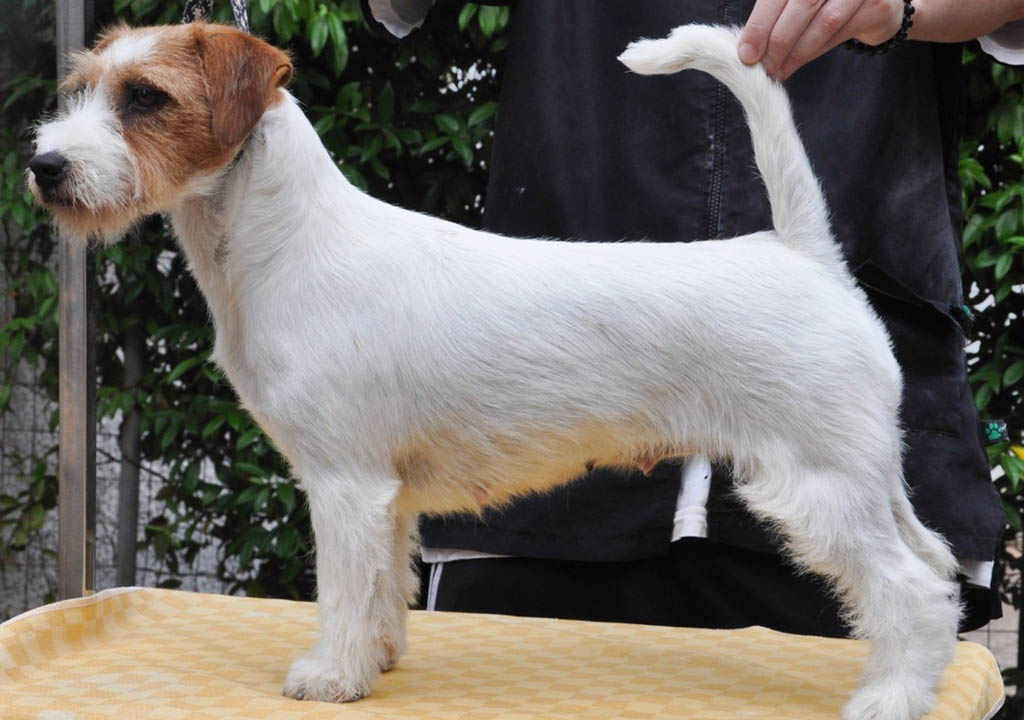
The overall dog is longer than high, i.e. rectangular. The depth of the body from the withers to the brisket should equal the length of foreleg from elbows to the ground. The girth behind the elbows should be about 40 to 43 cms.
BEHAVIOUR / TEMPERAMENT
A lively, alert and active Terrier with a keen, intelligent expression. Bold and fearless, friendly but quietly confident
HEAD
FACIAL REGION
Nose: Black.
Muzzle: The length from the stop to the nose should be slightly shorter than from the stop to the occiput.
Lips: Tight-fitting and pigmented black.
Jaws/Teeth: Very strong, deep, wide and powerful. Strong teeth closing to a scissor bite.
Cheeks: The cheek muscles should be well developed.
EYES: Small dark and with keen expression. Must not be prominent and eyelids should fit closely. The eyelid rims should be pigmented
black. Almond shaped.
EARS: Button or dropped of good texture and great mobility.
NECK: Strong and clean allowing head to be carried with poise.
HEAD
CRANIAL REGION
Skull:The skull should be flat and of moderate width gradually decreasing in width to the eyes and tapering to a wide muzzle.
Stop: Well defined but not over pronounced
BODY
Back: Level. The length from the withers to the root of tail slightly greater than the height from the withers to the ground.
Loin: The loins should be short, strong and
deeply muscled.
Chest: Chest deep rather than wide, with good clearance from the ground, enabling the brisket to be located at the height mid-way between the ground and the withers. Ribs should be well sprung from
the spine, flattening on the sides so that the girth behind the elbows can be spanned by two hands - about 40 cm to 43 cm. Point of
sternum clearly in front of the point of shoulder.
Tail: May droop at rest. When moving should be erect and if docked the tip should be on the same level as ears.
LIMBS
FOREQUARTERS
Shoulder: Well sloped back and not heavily loaded with muscle.
Upper arm: Of sufficient length and angulation to ensure elbows are set under the body.
Forelegs: Straight in bone from the elbows to the toes whether viewed from the front or the side. Forefeet: Round, hard, padded, not large, toes moderately arched, turned neither in nor out.
LIMBS
HINDQUARTERS
General appearance: Strong and muscular, balanced in proportion to the shoulder.
Stifle (Knee): Well angulated.
Hock joint: Low set.
Metatarsus (Rear pastern): Parallel when viewed from behind while in free standing position.
Hind feet: Round, hard, padded, not large, toes moderately arched, turned neither in nor out.
GAIT / MOVEMENT
True, free and springy.
COAT
Hair: May be smooth, broken or rough. Must be weatherproof. Coats should not be altered (stripped out) to appear smooth or broken.
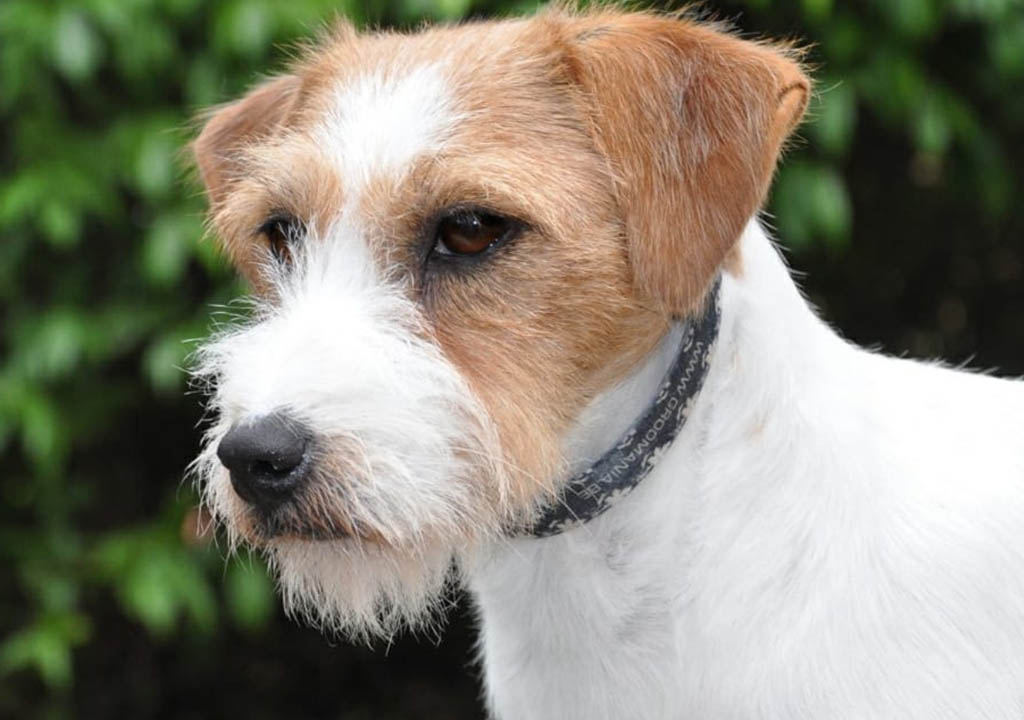
Colour: White must predominate with black and/or tan markings. The tan markings can be from the lightest tan to the richest tan (chestnut).
SIZE AND WEIGHT
Ideal Height at the withers: 25 cms to 30 cms.
Weight: Being the equivalent of 1 kg to each 5 cms in height, i.e. a 25 cms high dog should weigh approximately 5 kgs and a 30 cms high dog should weigh 6 kgs.
FAULTS
Any departure from the foregoing points should be considered a fault and the seriousness with which the fault should be regarded should be in exact proportion to its degree and its effect upon the health and welfare of the dog and on its ability to perform its traditional work.
- Lack of true terrier characteristics.
- Lack of balance, i.e. exaggeration of any points.
- Sluggish or unsound movement.
- Faulty mouth.
DISQUALIFYING FAULTS
- Aggressive or overly shy dogs.
- Any dog clearly showing physical or behavioural abnormalities
TEMPERAMENT
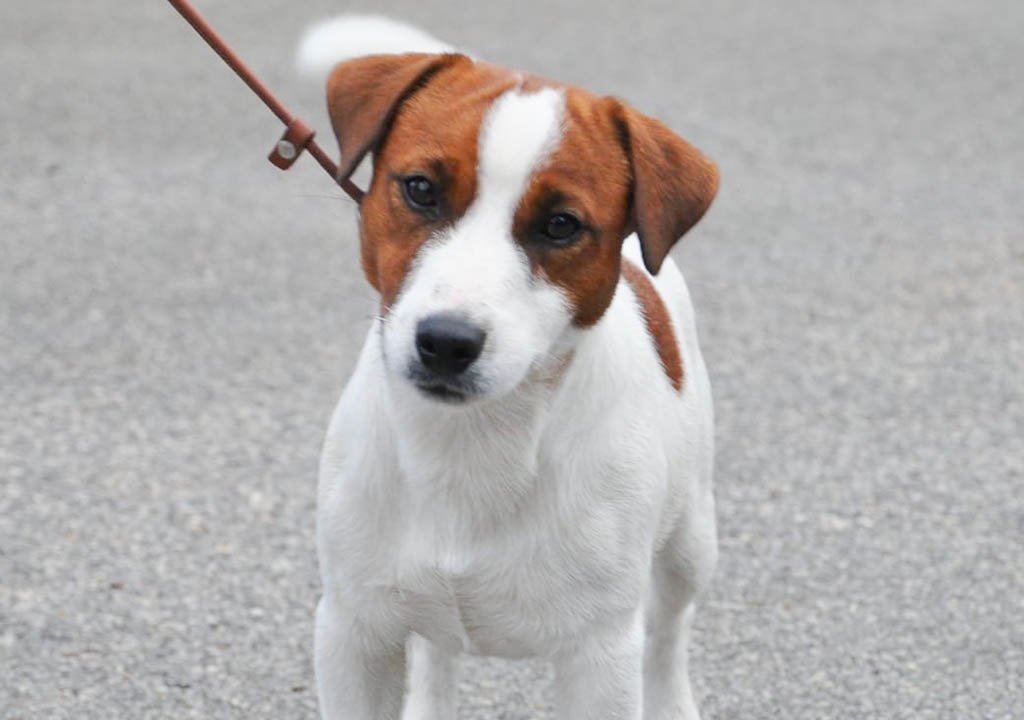
The British Breed Standard asks for the Russell to be "bold and friendly ". Other Standards use words such as "confident" and "fearless". Perhaps the American Standard sums up the breed best: "at work he is a game hunter, tenacious and courageous. At home he is playful, exuberant and overwhelming affectionate. He is an independent and energetic terrier and requires his due portion of attention". Sheila Atter, Jack Russell Terriers Today
 EN
EN  IT
IT